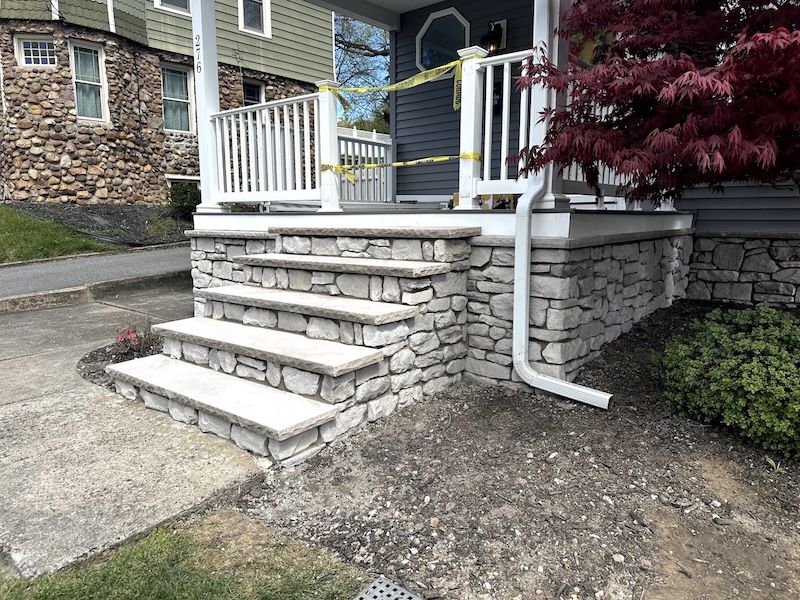
Steps & Stoops Installation in Totowa, NJ Serving North Jersey: Built on the Right Foundation
Schedule Your Free AssessmentIn North Jersey, front steps take a beating. The salt from the plows, water that freezes overnight, and people going in and out every single day. It all adds up. We install brick, stone, and block masonry steps for residential entries and walkways across Bergen, Passaic, Morris, and Essex counties. Most projects take 3 to 5 days once the footing is poured. And honestly, the footing is the part that matters most. Get that right, below the frost line with the right base, and your steps stay level for decades. That is what masonry steps installation in North Jersey comes down to. Steps and stoops are everyday work for a North Jersey masonry contractor like us.
A lot of the homes around Totowa, Clifton, and Paterson were built decades ago, and the front steps on those houses were often poured on footings that never went deep enough. Our frost line here runs about three feet down, so anything shallower will lift and settle every winter until the treads pull away from the house. When we build steps we dig below that depth first, because a stoop that moves is both a trip hazard and an expensive thing to fix twice. If you have ever wondered where the stoop came from in the first place, here is the history behind the North Jersey stoop.
Every Masonry Step Needs a Footing Below Frost Line
If you are replacing crumbling front steps on a Colonial or Cape Cod in Bergen or Passaic County, it starts in the footing. A concrete footing anchors your steps to solid ground, preventing them from shifting or settling over time. It sits on undisturbed soil at least 8 inches thick per IRC R4035 and must extend below 36 inches. That is the frost depth here in North Jersey.
If you were to pour steps on bare dirt, you would be asking for trouble. Soil moves and washes out over time. A compacted gravel base under the footing gives you drainage and a stable surface to build on. Clay soils in towns like Wayne and Clifton make this even more of a factor. Clay holds more water, and when that water freezes, the pressure pushes everything upward.
Proper Separation Prevents Cracking
One question many homeowners ask is whether the steps should be attached directly to the house foundation. They shouldn't be. We use an isolation joint between the steps and the home so the two structures can move independently, preventing cracking in both.
NJ's Uniform Construction Code5 requires a permit for new step construction in most municipalities, and your contractor should handle that before any work begins.
Rebar and Reinforcement Keep North Jersey Steps Stable for Decades
Steel rebar is required for exterior masonry steps. It ties the footing, walls, and treads into a single connected structure. If you skip it, the concrete relies solely on compressive strength. That may hold up fine until frost pushes in sideways or the ground shifts underneath. This is when cracks begin to appear. It starts with the corners, then spreads to where the treads meet the risers.
If your steps have 4 or more risers or are wider than 4 feet, reinforcement is a must. Homes in hilly areas such as Wyckoff and West Orange tend to have taller step runs, which increases the load on the structure. North Jersey averages over 80 days below freezing each year. That kind of expansion and contraction breaks unreinforced concrete apart over time.
Some people ask if adding extra rocks to the mix makes concrete stronger. There is already aggregate in the mix, and it is a standard ingredient. But gravel can resist compression, and rebar resists tension. They do different jobs, and both are needed. The MCAA recommends reinforced construction1 for any exterior masonry exposed to freeze-thaw cycles, which is essentially every front step in New Jersey.
Mortar Type and Brick Layout Determine How Long Steps Last
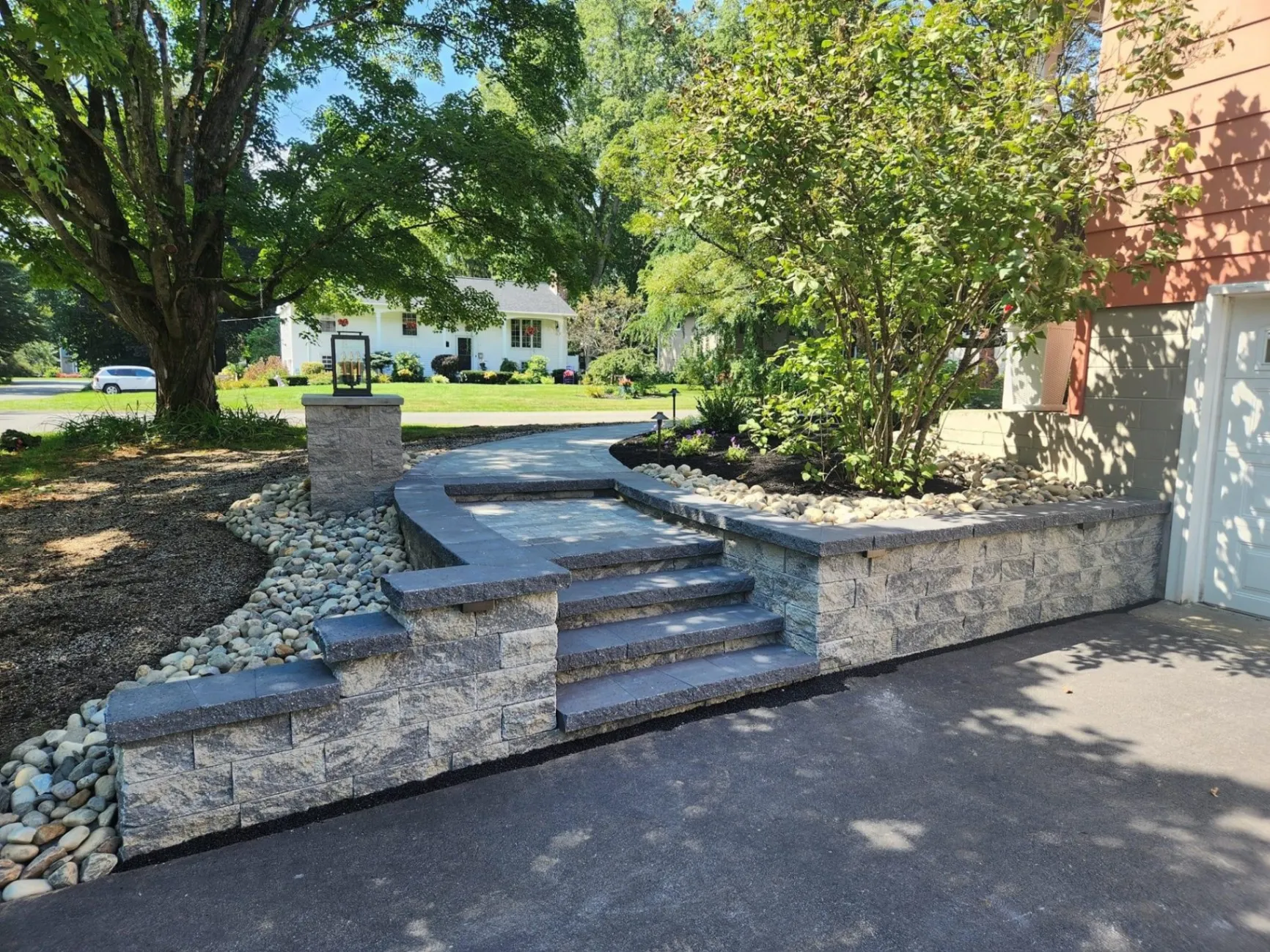
Mortar is what bonds the brick or stone veneer to the concrete block body of the steps. Not all mortar is the same. ASTM C2703 defines five types based on compressive strength. For exterior steps, Type S is the standard. It provides at least 1,800 PSI and holds up well in wet and cold conditions. Using a weaker type on an outdoor step in North Jersey is a shortcut that will show up later.
Brick is the most common step-facing material in Bergen County and in neighborhoods such as Glen Ridge and Morristown. The veneer gets laid in courses over a concrete block core. Stretcher and rowlock courses alternate to form the risers and treads. Each course has to be level and plumb. A mortar bed bonds the brick to the substrate, and in some cases, a scratch coat is applied first to improve adhesion. Joints get tooled after placement to shed water and resist freeze-thaw damage.
Timing also matters on the concrete. Fresh concrete should be placed within 90 minutes of batching. After that, the mix starts to set and loses workability. Adding water back in to loosen it up weakens the finished product. Many Bergen County municipalities have aesthetic standards for front entries, so material selection is not just about durability. Your contractor should be able to match the brick or stone to your home's existing style.
Riser Height and Tread Depth Must Meet New Jersey Building Code
Pull a permit for new steps in Essex or Morris County, and the inspector is going to check your measurements. New Jersey adopts the IRC under the Uniform Construction Code, N.J.A.C. 5:235, with state-specific amendments. The numbers are pretty straightforward. The maximum riser height is 7-3/4 inches for residential. Minimum tread depth is 10 inches. And here is the one that trips people up. The height between any two risers in the same flight cannot vary by more than 3/8 of an inch. Even a small difference can change your stride and create a trip hazard, pun intended.
Handrails are required4 on any stairway with 4 or more risers. Height must be between 34 and 38 inches. If your home is undergoing a sale or inspection, these are the items that are flagged. Buyers in Bergen and Passaic County see it on inspection reports all the time.
You may have heard of the "rule of 25" or the "rule of 27." These are comfort guidelines, not code. The rule of 25 states that the sum of riser height and tread depth should be approximately 17 to 18 inches. The rule of 27 says two times the riser height plus the tread depth should land around 24 to 25 inches. Both help create a natural stride, but NJ code sets hard maximums and minimums. Permit requirements vary by town, though most municipalities in North Jersey require one for new masonry steps.
Common Installation Mistakes That Lead to Early Step Failure
Most of the step failures we see in Clifton, Passaic, and Paterson trace back to the same few shortcuts. No footing. Wrong mortar. Poor drainage. Pick any one of those and the steps are on borrowed time. Pick two and you might be looking at a replacement in under ten years.
On the concrete side, pouring on frozen ground is a problem we run into more than you would think. So is adding too much water to the mix to make it easier to work with. It spreads easier, sure. But the finished slab comes out weaker. Skipping control joints is another one. And if concrete is not kept moist for at least 7 days during curing, it never reaches full strength. The 90 minute rule applies here too. Concrete has to be placed within 90 minutes of batching. After that window, adding water back in to re-temper the mix does more harm than good.
Brick has its own set of problems2. Laying dry brick without dampening it first pulls moisture out of the mortar too fast. Inconsistent joint thickness looks bad and performs worse. Wrong mortar type for an exterior application, that one speaks for itself. North Jersey's clay soils hold onto moisture, and when winter hits, all that water expands. Tree roots near the foundation can shift footings over time too. Mature oaks and maples are great for shade. Not so great for what is happening underground.
Do You Need a Footing for Masonry Steps in North Jersey?
Yes. Masonry steps in North Jersey need a concrete footing below the local frost line. That depth is 36 inches in this part of the state. A footing keeps the steps from shifting when the ground freezes and thaws each winter. Without one, steps can settle, crack, or pull away from the house within a few seasons.
- The footing should be at least 8 inches thick and rest on undisturbed soil per IRC R4035
- Footings must extend a minimum of 12 inches below finished grade
- New Jersey's Uniform Construction Code (N.J.A.C. 5:23) requires a permit for new step construction in most municipalities
Frequently Asked Questions
Do I need a permit to install masonry steps in North Jersey?
Yes, most municipalities in Bergen, Passaic, Morris, and Essex counties require a construction permit under NJ's Uniform Construction Code (N.J.A.C. 5:23). Your contractor should pull the permit before work begins.
How deep does the footing need to be for masonry steps in North Jersey?
The frost line in North Jersey is 36 inches, and footings must reach below that depth to prevent heaving. IRC R403 sets the minimum thickness at 8 inches on undisturbed soil.
What type of mortar is best for exterior masonry steps?
Type S mortar is the standard for exterior step construction. It provides at least 1,800 PSI compressive strength per ASTM C270 and holds up well in wet and cold conditions.
Can masonry steps be built in winter in North Jersey?
Yes, with precautions. Mortar should not be mixed or applied when temperatures are below 40°F and falling. The BIA recommends heated materials and wind barriers during cold weather masonry construction.
How long do masonry steps last in North Jersey?
Properly built masonry steps with a footing below frost line, rebar reinforcement, and Type S mortar typically last 30 to 50 years in North Jersey's climate. Ongoing tuckpointing and sealing extend the lifespan further.
Should I choose brick, stone, or block for my new front steps?
All three work well. Brick is the most common facing material in North Jersey neighborhoods. Natural stone offers a higher-end look. Block is durable and cost-effective. A masonry contractor can match the material to your home's style.
See Our Work in Action
Need a Masonry Steps Installation?
If you've got a project you've been putting off, or something that needs attention now, we're here to help. No pressure, just honest advice.
Need A Mason Contractor? Request An Estimate!
Fill out the form and we'll get back to you promptly.