
Ask three contractors what a retaining wall costs and you'll likely hear three very different numbers. Most of that gap comes from things you can't see once the wall is done: how deep the base goes, how much drainage stone sits behind the block, and whether the wall needed an engineer.
We're Masonry Pro Construction, a family masonry company in Totowa. Biagio has been building walls across North Jersey for more than 35 years, and his son Gino works right alongside him. This page lays out the price ranges we actually see on jobs in Passaic, Bergen, Essex and Morris counties, and what pushes a wall from one end of the range to the other. For the full picture of how we build them, see our page on retaining wall installation in Totowa.
Estimated Retaining Wall Cost Ranges in North Jersey

These are estimated ranges from walls we've built, not a quote. Your yard sets the real number.
- Small walls: about $5,000 to $7,500. A low wall along a walkway, a planting bed or the edge of a driveway.
- Average walls: about $10,000 to $20,000. Most backyard walls that level out a slope so you can actually use the lawn or add a patio.
- Large walls: about $25,000 to $60,000 or more. Longer and taller walls, tiered walls, and walls with steps, lighting or a patio built on top.
Two walls the same length can land far apart. Height, drainage, the ground you're digging into and how easy it is to get a machine into the yard do most of the moving.
Why Four Feet Is the Big Price Jump
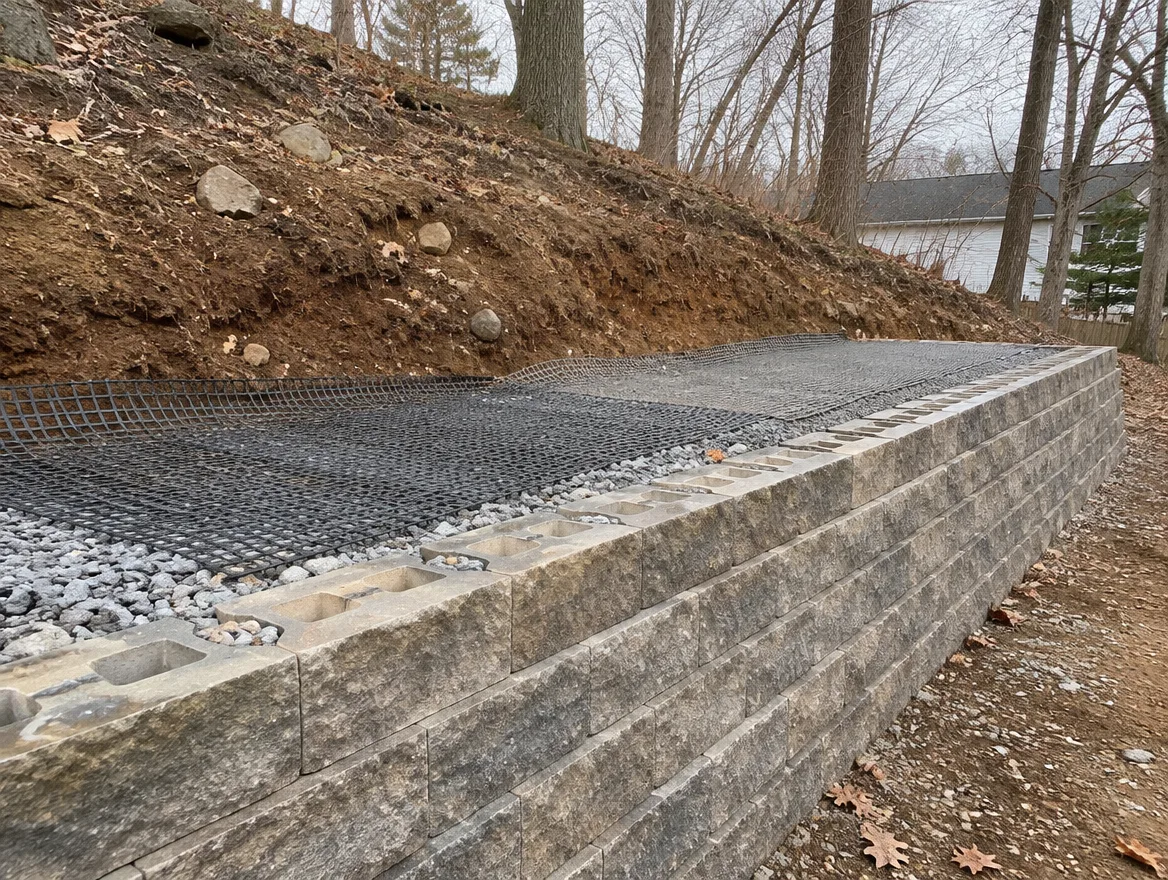
Height is the single biggest factor in what a wall costs. Once a wall goes over four feet, New Jersey treats it as a structure that needs a design from a licensed engineer. The state building code (N.J.A.C. 5:23-2.14(g)1) and the residential code it follows (IRC R404.42) set that line statewide, so it's the same in Wayne as it is in Ridgewood or Montclair.
That engineering changes the build, not just the paperwork. A wall that tall holds back a lot more soil, and that soil gets heavier every time it rains. So the plans call for a deeper, wider base, more compacted stone, more drainage stone, and layers of geogrid. Geogrid is a strong mesh laid between courses of block and run back into the hillside, so the soil itself helps hold the wall in place. The Federal Highway Administration's design guide for reinforced soil walls7 explains how that works.
None of that is an upsell. It's what keeps a tall wall standing through a North Jersey winter. If your wall is close to four feet, ask us whether shaving a few inches or splitting it into two shorter tiered walls makes more sense than paying for engineering. Sometimes it does and sometimes it doesn't, and we'll tell you straight which one fits your yard.
What North Jersey Ground Adds to the Price
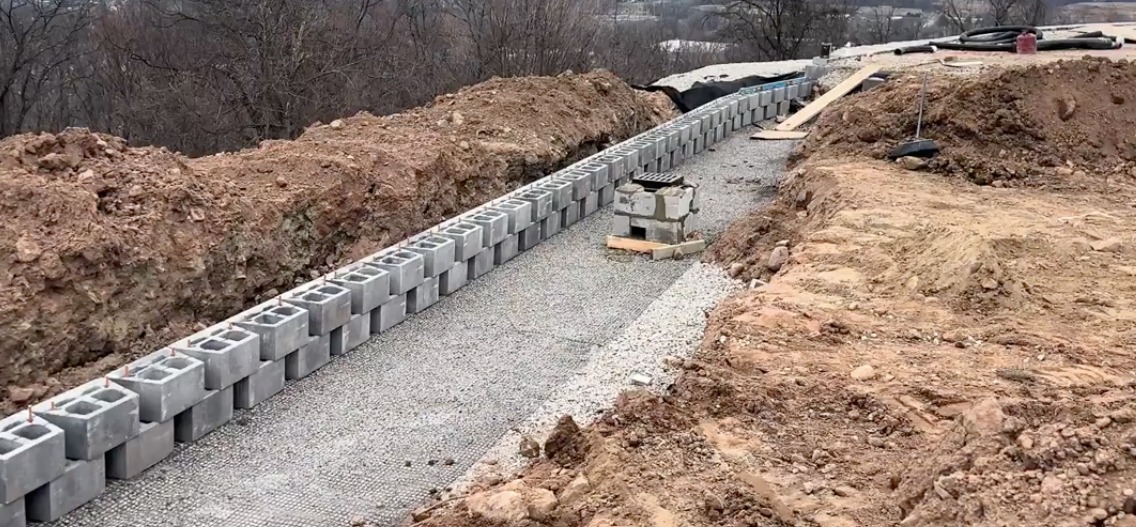
Our soil is part of the price, and it's different from what you'll read about on national cost sites. Most of North Jersey sits on glacial till, the dense, rocky mix of clay, sand and stone the glaciers left behind. Soils like the Boonton3 and Haledon4 series are common across our four counties. In fact, the USDA's official description of the Boonton series uses a spot right here in Totowa as its reference location. Many of them have a hard, packed layer a foot or two down called fragipan, and water has a hard time getting through it.
For a retaining wall, that means two things. First, water tends to sit right behind the wall instead of draining away, so drainage isn't optional here. Second, digging takes more effort. It's common to pull out cobbles and boulders while cutting into a slope, and closer to the Watchung ridges, which are basalt, or up in the Highlands5 around Kinnelon and Ringwood, where the bedrock is granite and gneiss, you can hit ledge rock. Rock and boulders take time and equipment to deal with, and that shows up in the estimate.
You can look up what's under your own yard on the USDA Web Soil Survey6. We'll also tell you what we see when we walk the property.
Drainage Is Part of the Price, Not an Extra

Water is what takes walls down. When rain and snowmelt build up behind a wall with nowhere to go, the pressure pushes the block forward a little more every season. Then winter makes it worse. Water in the soil freezes, expands and shoves on the back of the wall, then thaws and does it again.
Every wall we build gets clean drainage stone behind the block, a perforated pipe at the base that carries water to an outlet, and filter fabric so soil doesn't clog the stone over time. That's the same setup the National Concrete Masonry Association8 lays out for segmental walls. On a cheap quote, this is usually the first thing to shrink or disappear. The wall looks the same on day one. By the third winter, it doesn't.
On a job in Kinnelon, where we built walls along a driveway, the drainage behind them was a big part of the work. It's the part nobody sees once the wall is done, and it's the part that keeps the wall straight.
Block, Stone or Concrete

Material moves the price too. Most of the walls we build are segmental block, the interlocking concrete wall block made by brands like Cambridge and EP Henry. Block comes in a lot of colors and textures, it handles freeze-thaw well when the base and drainage are right, and it fits most budgets in the ranges above. On a sloped yard in Wayne, we built a wall from Cambridge Sigma block in Onyx Natural with low-voltage lighting, which turned a rocky hillside the kids couldn't use into real yard space.
Natural stone costs more. The material is pricier, and every stone is fitted by hand, which takes longer. Poured concrete makes sense in a few spots, like along a foundation or a driveway cut, and it needs forms and more equipment.
Caps, corners, curves, built-in steps, columns and lighting all add to the total. They're also what make a wall look finished instead of plain.
Other Things That Move the Number

- Taking out an old wall. Plenty of older homes here still have timber or railroad-tie walls that are rotting out. Those have to come out and be hauled away before the new wall goes in.
- Access. If a machine can't get into the backyard, block and stone move by hand, and that takes longer.
- Length and shape. Long runs and curves take more block and more cuts.
- Grading and backfill. Leveling the yard behind the wall or bringing in fill to build it up adds material and labor.
- Permits. Walls over four feet need permits and engineering. Many towns here also want a zoning permit for shorter walls, and the rules change from town to town.
- What sits near the top. A patio, pool, driveway or shed near the top of the wall adds weight, which can change the design.
Repair or Replace?

If you already have a wall that's leaning, bulging or has caps pulling apart, the cost question is a little different. Sometimes a section can be rebuilt with proper drainage behind it. Sometimes the whole wall needs to come out. We look at why it moved before quoting either one, so you're not paying for a fix that fails again in two winters.
Paying for a Bigger Wall

A wall can be a big project, especially once it needs engineering. We offer financing through our partner Acorn Finance, so you can spread the cost out over time. Checking your offers won't affect your credit score.
Common Questions About Retaining Wall Cost in North Jersey
How much does a retaining wall cost in North Jersey?
Most retaining walls we build in North Jersey fall between about $5,000 and $60,000 or more. A small wall runs about $5,000 to $7,500, an average backyard wall about $10,000 to $20,000, and large or engineered walls $25,000 to $60,000 or more. These are estimated ranges, not a quote.
Why does a wall over 4 feet cost so much more?
New Jersey requires a licensed engineer's design once a wall goes over four feet. The plans call for a bigger base, more drainage stone and geogrid reinforcement in the soil behind the wall, so both material and labor go up.
Does North Jersey soil affect the price?
Yes. Much of the area sits on dense, rocky glacial till that holds water and can hide boulders or rock. That means more digging and more drainage work than you'd need in loose, sandy soil.
Do I need a permit for a retaining wall?
Walls over four feet need permits and an engineered design. Many North Jersey towns also want a zoning permit for shorter walls, and the rules vary by town. We help you check before any work starts.
Can you build a retaining wall in winter?
Often, yes. We work through most of the winter when the weather allows. Winter is also a good time to get an estimate and a spot on the schedule before the spring rush.
Get a Real Number for Your Wall
The only way to price a wall is to stand in the yard and look at the slope, the soil and where the water goes. We offer free on-site estimates across Bergen, Passaic, Essex and Morris counties, with no trip fee. Masonry Pro Construction is family owned, licensed and insured, NJ HIC #13VH06777200, and we've been building walls in North Jersey for more than 35 years. You can also see how we plan and build every wall on our retaining walls page.