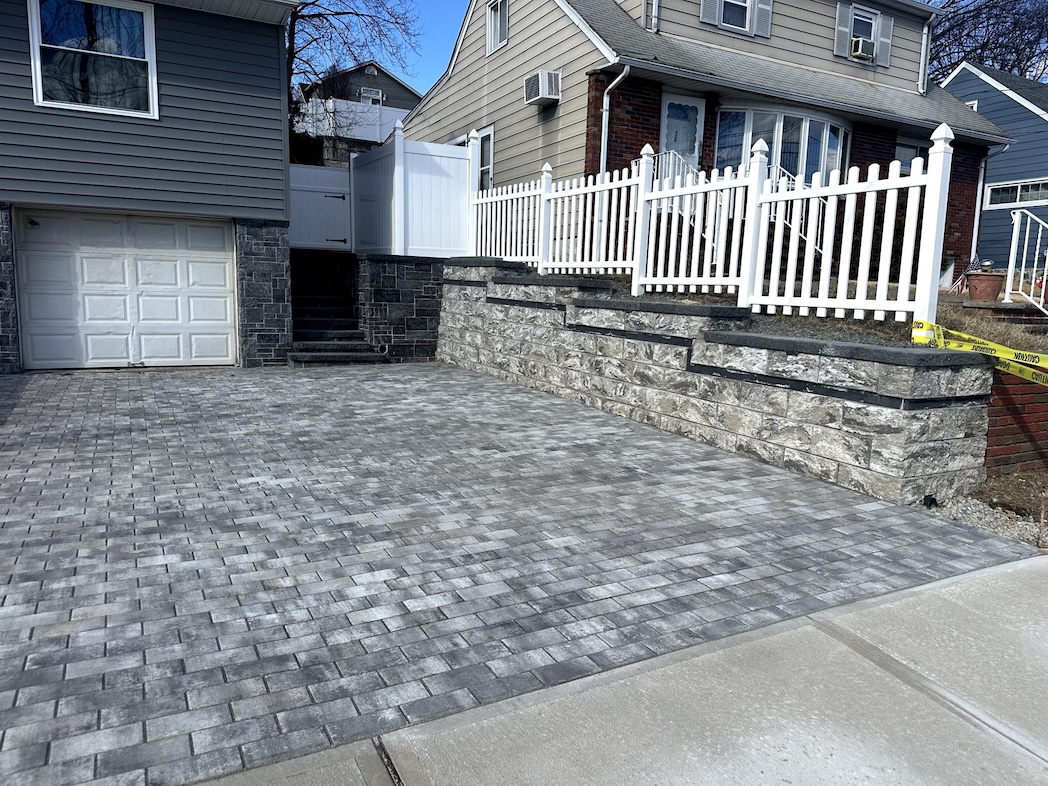
The sand between your pavers does more work than it looks like. It locks the pavers together so they don't shift, keeps weeds from taking root, and slows down the ants. When it washes out, the whole patio starts to loosen up.
We're Masonry Pro Construction, a family company and masonry contractor in Totowa. Biagio has more than 35 years in the trade, and his son Gino runs the jobs in the field. This page covers how often pavers need new joint sand, how to tell when yours do, and when empty joints are a sign of something bigger. For lifting and resetting pavers that have already sunk, see our page on paver patio repair in Totowa.
What Polymeric Sand Does

Polymeric sand is fine sand mixed with a binder. It gets swept into the joints dry, then misted with water. As it dries, the binder sets and the sand firms up. It stays flexible enough to move a little with the pavers, but it holds much better than plain sand against rain, wind, and a garden hose.
When the joints are full and firm, the pavers press against each other and act like one surface2. When the joints empty out, each paver can rock and shift on its own. That's when edges start to chip and low spots start to show.
How Often Pavers Need Re-Sanding
Plan on a full re-sand about every 7 to 15 years. That's a wide range, because a few things decide where your patio falls:
- The sand that went in. Better polymeric sand, installed right, lasts longer.
- Drainage. Joints that sit under a gutter or a downspout wash out faster.
- Traffic. A front walk or a driveway wears faster than a quiet corner of the yard.
- Cleaning. Heavy pressure washing too close to the joints can blast sand out.
Check Your Joints Every Spring
Winter is when the damage happens3, so spring is the time to look. Walk the patio after the snow is gone and look at the joints:
- If the sand is still firm and level with the paver edges, leave it alone. There's nothing to gain by redoing joints that are doing their job.
- If a few spots washed out early, spot-repair just those joints. There's no need to redo the whole patio for a few bad areas.
- If whole sections are empty, or weeds are growing all through the joints, it's probably time for a full re-sand.
When Empty Joints Mean Something Bigger

Sometimes the sand isn't really the problem. If the same joints keep emptying out after every heavy rain, water is running through that spot. New sand alone won't hold there.
So before we replace the sand, we check the drainage. Is a downspout dumping onto the patio? Does the patio pitch toward the house? Is water coming off a slope behind it? We fix where the water goes first. Otherwise you're paying to re-sand the same joints every year.
If the pavers in that area have already sunk or started to rock, the base underneath has moved too. That's a repair, not a re-sand. We lift that section, correct the base, reset the pavers, and finish with new joint sand.
What It Costs
A re-sand on its own is a fairly small job. When pavers have to be lifted and reset, the price goes up because the base gets fixed too. On our North Jersey jobs, lifting, resetting, and re-sanding usually runs about $12 to $21 per square foot of the repaired area. A 100 square foot repair, for example, is about $1,200 to $2,100. Access, drainage work, and the condition of the base change the number. These are estimated ranges, not a quote.
Why Not Just Do It Yourself?
You can buy polymeric sand at any home center, and plenty of homeowners give it a try. The catch is in the details. The joints need to be cleaned out deep enough, the pavers have to be completely dry, every bit of sand has to come off the paver surface before it gets wet, and the misting has to be just right. Miss one of those, and you get a hazy film on the pavers or sand that never sets. The bag's instructions matter, and the manufacturer's guidelines1 are worth reading before you start.
Common Questions About Re-Sanding Pavers in North Jersey
How often do pavers need to be re-sanded?
Plan on a full re-sand about every 7 to 15 years, depending on the polymeric sand used, drainage, traffic, and cleaning. Check the joints each spring and spot-fix any that wash out early.
What is polymeric sand?
It's fine sand mixed with a binder. It's swept into the paver joints dry, then misted with water so the binder sets. It holds up much better than plain sand against rain and weeds.
Should I re-sand my whole patio if a few joints are empty?
No. If the rest of the sand is firm, just spot-repair the joints that washed out. A full re-sand makes sense when whole sections are empty.
Why do the same paver joints keep washing out?
Usually it's water. A downspout, a bad pitch, or runoff from a slope can keep emptying the same joints. We fix the drainage first, then replace the sand.
How much does paver patio repair cost?
On our North Jersey jobs, lifting, resetting, and re-sanding usually runs about $12 to $21 per square foot of the repaired area. A 100 square foot repair is about $1,200 to $2,100. These are estimated ranges.
Want Us to Take a Look?
If your joints are washing out or your pavers are starting to move, we'll come out and tell you whether it's a re-sand, a repair, or a drainage fix. Free on site estimates across Bergen, Passaic, Essex, and Morris counties. To see how we handle bigger repairs, visit our page on paver patio repair.
Masonry Pro Construction is family owned, fully licensed, and insured, NJ HIC License #13VH06777200.